
When Can a Ceramic Coating Cure in Baton Rouge? 20 Years of Weather Data
An open study of UV, heat, humidity and rain at Baton Rouge Metro Airport, the months a coating can be applied and stay dry, and how Baton Rouge compares with 11 other U.S. cities for car paint.
Short answer: Baton Rouge cars spend about 111 days a year at 90°F or hotter and about 117 days under a very high UV index, and in July only about 2 days allow a ceramic coating to be applied outdoors and stay dry for the 24 hours most coatings need. October is the best month, with about 21 such days, followed by March, April and November with about 20 each. Of 12 U.S. metros we compared, Baton Rouge has the harshest climate for car paint outside Florida.
By Matthew Mire, founder of Immaculate Detailing of BR, with data analysis by Andres Rusic of Marketing & AI. Data: NOAA and NASA, 1950–2025. Published October 21, 2026.
Key findings
- Heat: Baton Rouge Metro Airport averaged 111 days at or above 90°F from 2016 to 2025, including 34 days at 95°F or above. The 1991–2020 average was 96 days.
- It is getting hotter: 90°F days have risen by about 3 per decade since 1950 (Sen's slope +2.9; Mann-Kendall p = 0.014). The 2020s are averaging 112 such days, against about 82 in the 1970s and 1980s.
- UV: about 117 days a year reach a peak UV index of 8 ("very high") or more, from April through September. There was no significant trend in UV days from 2006 to 2025.
- Humidity: 59% of all hours, about 5,200 a year, are at 80% relative humidity or higher, the most of any warm-climate city we compared.
- Hot-sun rain: about 21 days a year bring measurable rain on a day that also reaches 90°F and very high UV. Droplets dry fast on hot paint, which is how water spots and etching start. These days cluster in June, July and August.
- Cure windows: airport observations show an average of 165 days a year that allow a coating to be applied in 50–86°F weather at 80% humidity or less, with no rain for the next 24 hours. June has about 7, July about 2 and August about 2.
- Compared with other cities: Baton Rouge ranks 3rd of 12 metros on a combined paint-stress score, behind Tampa and Miami and ahead of Houston, New Orleans and Phoenix.
When is the best time to get a ceramic coating in Baton Rouge?
October is the best month to get a ceramic coating in Baton Rouge, with about 21 days a month that fit an outdoor application and a dry 24-hour cure. March, April and November follow with about 20 each. July and August are the hardest months, with about 2 qualifying days each, because afternoon storms and temperatures above 86°F rule out most days.
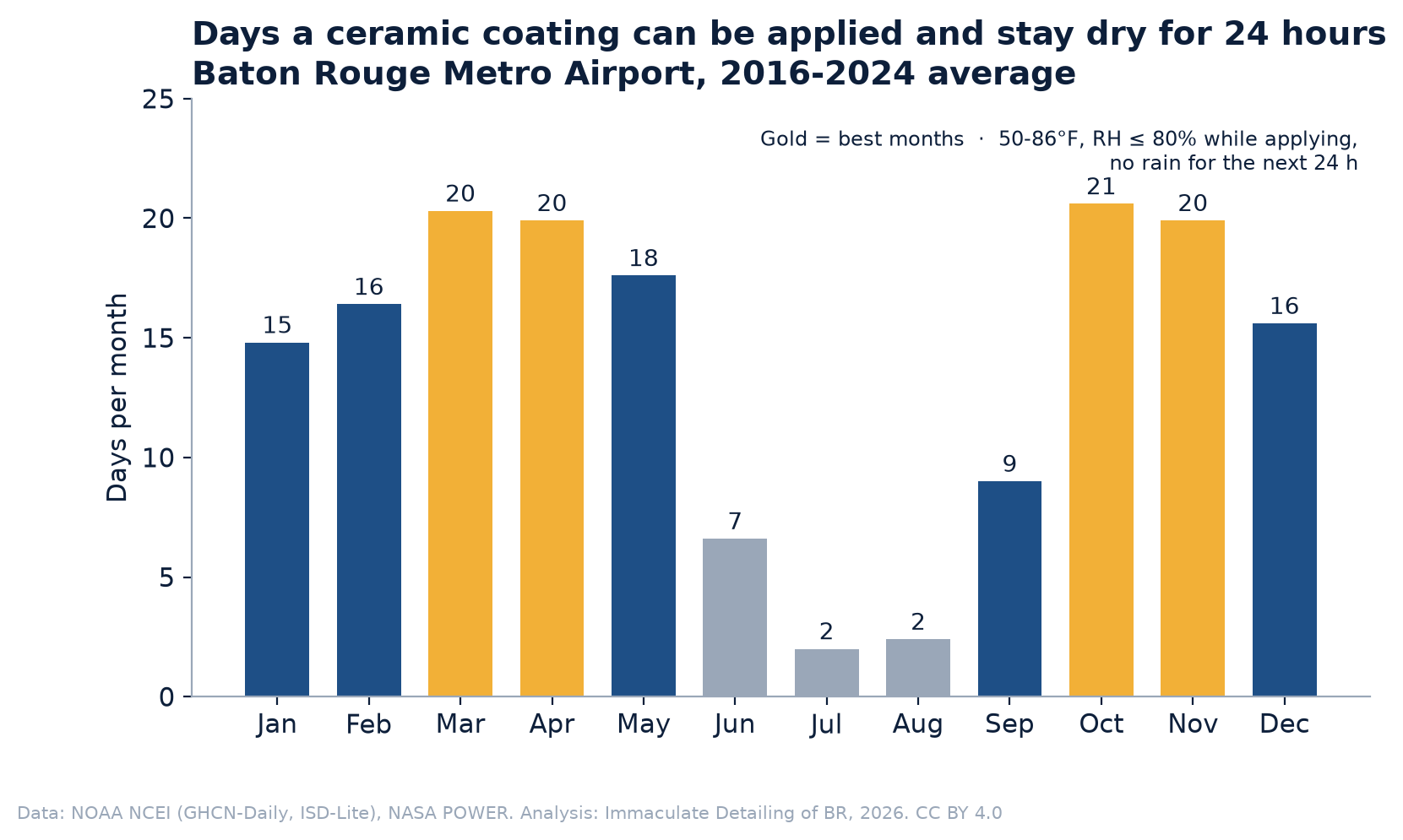
Days per month a coating could be applied outdoors at 50–86°F and 80% humidity or less, with no rain for the following 24 hours. Baton Rouge Metro Airport hourly observations, 2016–2024 average.
| Month | Cure-window days | 90°F+ days | UV 8+ days | Hot-sun rain days |
|---|---|---|---|---|
| January | 15 | 0 | 0 | 0 |
| February | 16 | 0 | 0 | 0 |
| March | 20 | 0 | 4 | 0 |
| April | 20 | 0 | 14 | 0 |
| May | 18 | 10 | 20 | 1 |
| June | 7 | 23 | 23 | 5 |
| July | 2 | 26 | 22 | 6 |
| August | 2 | 25 | 22 | 5 |
| September | 9 | 18 | 11 | 1 |
| October | 21 | 4 | 0 | 0 |
| November | 20 | 0 | 0 | 0 |
| December | 16 | 0 | 0 | 0 |
Booking in summer? A summer coating is still possible. It needs a garage or covered space, an early start before the panels heat up, and a place to keep the car dry for the next 24 hours. Plan for that before the appointment. See ceramic coating in Baton Rouge for packages and pricing.
How hard is Baton Rouge weather on car paint?
Baton Rouge has the harshest weather for car paint of the 12 U.S. metros we compared outside Florida. It ranks 3rd overall on a combined score of yearly UV dose, 90°F days, humid hours and hot-sun rain days, behind Tampa and Miami. Coating makers have long used South Florida as an outdoor test site for automotive paint because it combines sun, heat and moisture. Baton Rouge shares that combination.
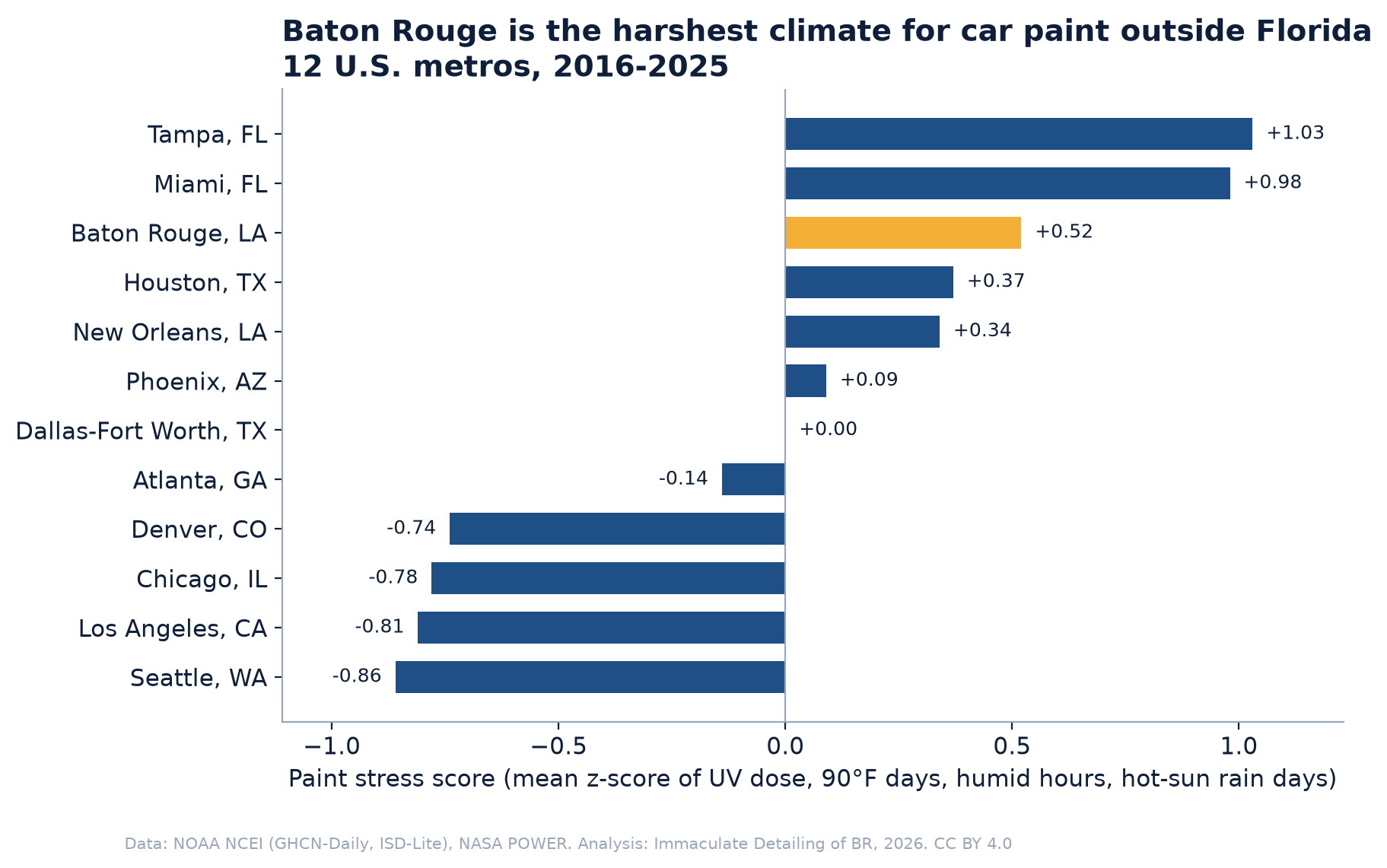
Paint stress score is the average z-score of four measures across the 12 cities. Higher is harsher. 2016–2025.
| Metro | Rank | UV 8+ days | 90°F+ days | Hours at 80%+ RH | Hot-sun rain days |
|---|---|---|---|---|---|
| Tampa, FL | 1 | 162 | 123 | 4,349 | 40 |
| Miami, FL | 2 | 155 | 112 | 3,875 | 43 |
| Baton Rouge, LA | 3 | 117 | 111 | 5,212 | 21 |
| Houston, TX | 4 | 118 | 124 | 4,466 | 14 |
| New Orleans, LA | 5 | 117 | 101 | 4,481 | 18 |
| Phoenix, AZ | 6 | 159 | 181 | 263 | 8 |
| Dallas-Fort Worth, TX | 7 | 117 | 115 | 3,126 | 9 |
| Atlanta, GA | 8 | 93 | 61 | 4,501 | 11 |
| Denver, CO | 9 | 109 | 56 | 764 | 8 |
| Chicago, IL | 10 | 28 | 21 | 4,734 | 3 |
| Los Angeles, CA | 11 | 114 | 6 | 2,099 | 0 |
| Seattle, WA | 12 | 12 | 7 | 6,002 | 0 |
Phoenix has far more heat and UV, but its dry air removes the moisture side of paint damage. Seattle has more humid hours than Baton Rouge, but little heat or UV. Baton Rouge is one of the few places in the comparison with all four stressors at once.
Is Baton Rouge getting hotter?
Yes. Days at 90°F or hotter at Baton Rouge Metro Airport have increased by about 3 per decade since 1950, a statistically significant trend (Sen's slope +2.9 days per decade, Mann-Kendall p = 0.014). The rise has been faster since 1990, about 7 more per decade. 2023 had 140 such days and 2024 had 139, the two highest counts since 1950.

NOAA GHCN-Daily, station USW00013970. Every year from 1950 to 2025 has at least 330 days of records.
What is a hot-sun rain day, and why does it matter for paint?
A hot-sun rain day is a day with measurable rain at the airport that also reaches 90°F and a peak UV index of 8 or more. Baton Rouge averages about 21 a year, almost all from June to August. Rain that lands on a hot car and then dries in strong sun leaves minerals and acids behind, and that is how water spots and etching marks start. A coating does not stop rain. It makes the water bead and roll off, so less of it is left to dry on the clear coat.
Which months are hardest on paint?
June, July and August are the hardest months on paint in Baton Rouge, with about 22–23 very-high-UV days, 23–26 days at 90°F+ and 5–6 hot-sun rain days each. UV builds earlier than heat: April already averages 14 very-high-UV days, before 90°F days start in May. Lovebug flights in spring and late summer add another hazard. University of Florida IFAS and the LSU AgCenter both note that lovebug remains are acidic and can damage paint if left on.

Monthly averages, Baton Rouge, 2006–2025.
How we measured it
- Heat and rain: NOAA GHCN-Daily, Baton Rouge Metro Airport (USW00013970), 1950–2025, plus the same record for each comparison city's main airport, 2016–2025.
- Hourly temperature, humidity and rain for cure windows: NOAA ISD-Lite hourly observations at Baton Rouge Metro Airport, 2016–2024.
- UV index and hourly humidity for all 12 cities: NASA POWER hourly data (CERES and MERRA-2), 2006–2025 for Baton Rouge and 2016–2025 for the comparison.
- Cure window: a start time between 8 a.m. and 2 p.m., 3 hours of application at 50–86°F and 80% relative humidity or less, then no rain for 24 hours from the start. The temperature range follows Feynlab's published range and the 24-hour dry period follows Adam's Polishes and Feynlab instructions. The humidity limit is our assumption, because no manufacturer we checked publishes one.
- Checks: modeled daily highs match the airport station at r = 0.97 and modeled monthly rain at r = 0.89. The modeled cure-window count is lower than the station count (124 vs 165 days a year) because modeled rain includes drizzle, but the month-by-month pattern matches at r = 0.98. Changing each threshold (12 or 48 hours dry, 70% or 90% humidity, other temperature ranges) moves the yearly total but not the best and worst months.
- Limits: these are airport weather records, not paint temperatures, and real paint damage also depends on parking, washing and protection. The paint stress score compares weather exposure; it does not measure damage.
Download the data
The data and charts are free to reuse under CC BY 4.0 with credit to Immaculate Detailing of BR.
- Full archive on Zenodo, DOI 10.5281/zenodo.23548351 (all files, charts and the Python code)
- Hugging Face dataset, with a browsable data viewer
- Daily Baton Rouge paint-weather records, 2006–2025 (CSV)
- 12-city comparison, 2016–2025 (CSV)
- Monthly profile for Baton Rouge (CSV)
- 90°F days per year, 1950–2025 (CSV)
- Methods and data dictionary (PDF)
Cite as: Mire, M., & Rusic, A. (2026). Baton Rouge Car Paint and Ceramic Coating Weather Dataset, 2006–2025 (Version 1.0) [Data set]. Immaculate Detailing of BR. https://doi.org/10.5281/zenodo.23548351

Frequently asked questions
How long does a ceramic coating need to stay dry after it is applied?
Most manufacturer instructions ask for 12 to 24 hours without water. Gtechniq asks for 12 hours indoors for Crystal Serum Light; Adam's Polishes and Feynlab ask for 24 hours. In a Baton Rouge summer a dry 24 hours outdoors is rare, so the car should stay under cover.
Can you get a ceramic coating in Baton Rouge in the summer?
Yes, with planning. Outdoors, July and August each average about 2 days that fit the conditions. In a garage, with an early start and a covered place to park for 24 hours, summer coatings work.
Why is Baton Rouge harder on car paint than Phoenix?
Phoenix has more heat and UV, but its air is dry. Baton Rouge combines strong UV, about 111 days at 90°F+, 59% of hours at 80%+ humidity and about 21 hot-sun rain days a year. Accelerated weathering tests for automotive paint combine light, heat and moisture for the same reason.
Does a ceramic coating stop water spots?
No coating stops rain. A coating makes water bead and roll off, so less of it sits on the clear coat and dries there. Spots that do form are usually easier to wash off.
Where does this data come from?
NOAA airport records for Baton Rouge Metro Airport (1950–2025) and 11 other U.S. airports, plus NASA POWER hourly UV and humidity. The full dataset and method are public under CC BY 4.0.
Related guides
Planning a ceramic coating?
We come to your driveway or garage across Greater Baton Rouge. Ask about timing when you book.
Call (225) 532-8666Get a Quote